
Why a £35 per hr Virtual Assistant is Cheaper Than You Think.
If you have ever thought about working with a Virtual Assistant and been put off by the hourly rate this is an absolute must read.
Here's a phrase that makes every Virtual Assistant's ears prick up: "£35 an hour? But I can hire someone on minimum wage for way less than that!"
On paper? You definitely can. If you look at raw numbers on a screen, of course £12 looks smaller than £35.
But in the real world of running a business, the maths works completely differently. If you are comparing a VA’s hourly rate to an employee’s basic salary, you aren’t comparing apples to apples. You are comparing a single apple to an entire orchard that you have to maintain, water, insure, and pay a pension to, and, of course, pay for the inevitable sick days too.
When you hire a member of staff, you aren’t just paying them to sit in the chair. You are paying for the chair and the floor under the chair. You are paying for them to chat to colleagues and make their coffee (you may be paying for the actual coffee too). You are paying for the software on their screen, and the tax on their existence in your company. As a business owner, of course you know about ‘on costs’; but it is so easy to forget about them when reacting quickly to the cost of a Virtual Assistant Vs an employee.
Here’s an estimation of what actually happens to your bank account.
The Invisible Price Tag of an Employee
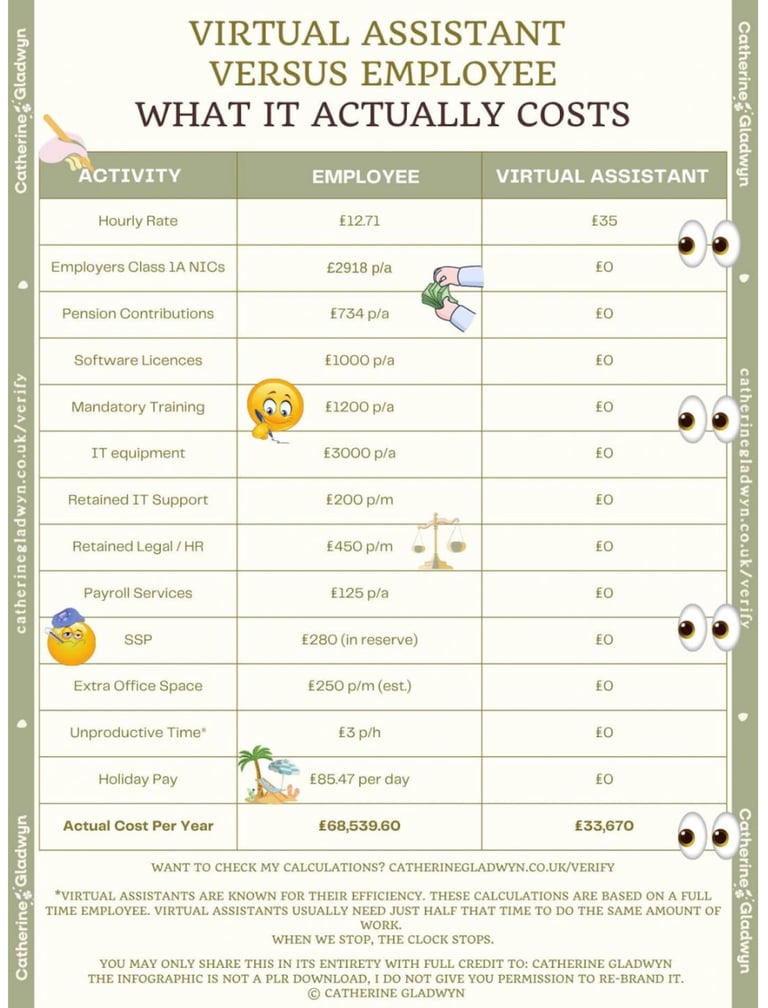
Say you hire a full-time employee at an hourly rate of £12.71. You think, “That’s roughly £24k a year. Well within budget.” Hold onto your hat, because here is what gets added to your bill behind the scenes:
The Taxman's Share: National Insurance contributions can easily tack on an extra £2,900+ a year.
The Tech Setup: An extra laptop, office equipment, and the necessary software licences (Microsoft 365, CRMs, security) usually average another £4,000 upfront and annually.
The Safety Net: Pension contributions, Statutory Sick Pay reserves, and mandatory training add thousands more.
The Overhead: HR support, legal advice, payroll services, and physical office space can easily add £7,000+ to your yearly outgoings.
By the time you add in holiday pay and the inevitable "unproductive time" (chatting by the kettle, scrolling through phones, or waiting for IT to fix a printer), that £12.71-an-hour employee actually costs your business closer to £68,500 a year.
Suddenly, the cheaper option is looking much pricier than planned.
With a Virtual Assistant, When We Stop, the Clock Stops
Here’s the alternative: you partner with a high-level Virtual Assistant at £35 an hour (That's the UK average price of a VA at the moment). When you look at the exact same amount of work being delivered over the year, the total cost sits around £33,670. Why? Because a VA is a business owner, not a staff member. A VA’s rate is all-inclusive. When you hire me (or any other VA), you pay for pure, uninterrupted productivity.
You pay £0 for my laptop.
You pay £0 for my software licences.
You pay £0 when I take a holiday, get a cold, or spend ten minutes talking to the dog (I actually don’t have a dog yet but it is the dream!).
Virtual assistants are built for efficiency. Because we run our own setups, we usually get the same amount of work done in half the time of a traditional employee. We don't stretch tasks to fill an 8-hour shift. We log in, clear the deck, streamline your systems, and log off. And you can control how much time you need to buy from us each month. Ad hoc hours? No problem. Retainer hours - 5hrs, 10 hours, 20 hours? Also no problem. Honestly, we sound too good to be true but I promise we’re not! It’s all real.
When the work stops, the clock stops. And your bill stops growing.
Stop Managing, Start Scaling
Beyond the literal thousands of pounds you keep in your business bank account, there is one final cost people forget: your own sanity.
When you hire an employee, you then have the job of managing them. You have to handle payroll, track performance, deal with HR compliance, and worry about keeping them busy.
When you hire a senior partner like a VA, you aren't managing a person; you are buying back your own time. You get exec-level leadership, organisation, and problem-solving without a single string attached. And so many VAs come from backgrounds which bring them a wealth of skills and knowledge that you can benefit from. (For example, in case you have missed my previous blog, I have been a teacher and Deputy Head for over two decades - I have many superpowers).
So, the next time you find yourself staring at an employee’s hourly rate, ask yourself: Do I want a “cheap” employee who costs me £68k, or a £35 expert who saves me thousands?
Let’s make the maths make sense for your business this summer, especially since my current rate at Victoria Jenner Virtual Assistance is actually sitting at a very competitive £33 an hour while I launch into this full-time chapter.
(Shoutout to Catherine Gladwyn for the brilliant graphic and calculations that inspired this breakdown as well as for being wonderful in every way!)
Victoria Jenner Virtual Assistance
Supporting Your Business Operations With Clarity And Calm.
Get in touch
victoria@victoriajennerva.co.uk
Based in Cumbria, working across the UK
(C) 2026 Victoria Jenner Virtual Assistance.
Operational Clarity and Calm